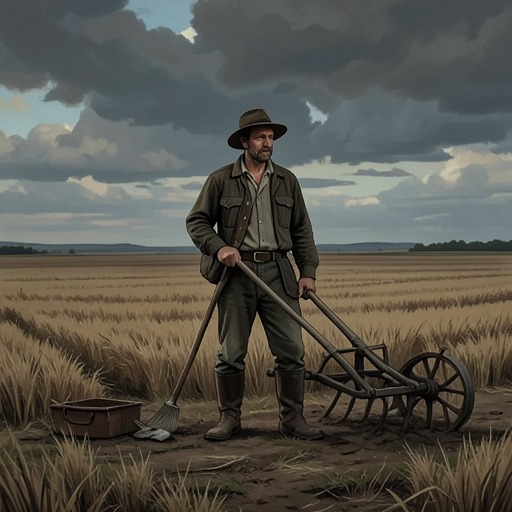
The lightning fire at Korpamoen’s hay barn
The EmigrantsThe lightning fire at Korpamoen’s hay barn destroys the harvested hay that remains to Karl Oskar and Kristina, transforming a sudden property loss into what Kristina identifies as God’s punishment for Karl Oskar’s earlier gesture of throwing hay upward. The family can carry water to the flames, but cannot save the barn; afterward, the buckets return home still half full, while Karl Oskar returns with his head bowed, believing that the Lord has answered his prayer by taking the rest of the hay.
The Fire Begins
After an earlier flash of lightning, the heavy rain that might have followed failed to arrive. A few drops struck the windowpanes, but the storm brought little water. Karl Oskar had gone back to bed when the window brightened again. This second light did not vanish like lightning: it remained, flickering and moving. He leapt up and recognized that there was a fire.
From the window, Karl Oskar could see that the light came from the hay meadow. The meadow barn had caught fire. He ran outside only half dressed, with Kristina following him. Nils and Märta had also awakened; Kristina called to them to look after the children. The fire’s first appearance as a persistent glow rather than a passing flash marks the change from anticipated rain to an emergency the household cannot control.
A Barn Beyond Saving
Karl Oskar went to the well, where two buckets had been filled from a forest spring. He thrust one at Kristina, and each hurried down the meadow with water. By the time they reached the barn, more than half of it had already burned. The fire had grown too large for their buckets to matter: flames climbed from the dry, shingled roof, which caught like tinder, and consumed the old barn and the harvested hay inside it.
The owners approached as close as the heat allowed, holding their pails and watching. They stood in astonishment, as if the destruction were a cruel story that could not be true. Neighbors arrived from nearby farms, but they too quickly understood that the barn could not be saved. Their remaining concern was to prevent the fire from spreading into the drought-dry woods. Fortunately, there was no wind; nevertheless, the rain had ended after only a few heavy drops, not enough even to wet the stones.
The barn burned swiftly. Hay and timbers became embers and sullen ashes, and Karl Oskar and Kristina walked back to the farmhouse slowly. There had been nothing they could do, and now nothing was urgent. They still carried their buckets, half full of water, and took the water home without thinking. The useless remainder of their attempted rescue gives physical form to the helplessness of the scene: they had brought water to a fire that had already outgrown any human effort to put it out.
Nils and the Family’s Witness
Nils had set out for the fire on his crutches, but had covered only half the distance when Karl Oskar and Kristina told him to turn back. He sat down to rest on the meadow stile. For many years he had not walked so far from the house. His brief journey brings the family’s impaired and aging body into the aftermath of a disaster that even the able-bodied cannot prevent; he reaches neither the barn nor a means of helping, but stops at the boundary of the meadow.
During the fire, Karl Oskar and Kristina had not exchanged a word. They looked at each other only a few times, perhaps thinking the same thoughts. Their silence ends on the walk home when Kristina recalls the summer harvest, when Karl Oskar threw hay upwards. She connects the fire to that earlier action and tells him that it happened as he had asked. Her interpretation turns the loss from an accident of weather into an answer to a prior gesture, and makes the remaining hay’s destruction feel like a sentence imposed on the family.
Punishment and the Lost Harvest
Kristina explicitly calls the fire punishment: God, she says, allows no mockery. Karl Oskar does not answer; he can find no reply. As he walks back to the house carrying his bucket, his head bent and his eyes on the ground, the narration confirms the force of her accusation for him. He believes she is right: this time the Lord had answered his prayer and had taken the rest of the hay.
The event thus completes a grim reversal. The harvest gesture, recalled only after the barn has burned, returns as a possible cause in the couple’s interpretation of the loss; what had been thrown toward heaven is answered by the loss of what remained on earth. The fire cannot be undone, and the rain that might have checked it has failed. In this way the burning barn does more than deprive the family of hay: it sharpens the story’s connection between drought, material vulnerability, and the fear that suffering has a divine meaning. Its immediate ending is not recovery or explanation but Karl Oskar’s silent acceptance of Kristina’s reading, as the family carries home the water that came too late.